Oct 20, 2026Guides
When Should You Use SEMS Screws Instead of Separate Washers?
Learn when to use SEMS screws instead of separate screws and washers, and how they can improve assembly speed, quality control and production efficiency.
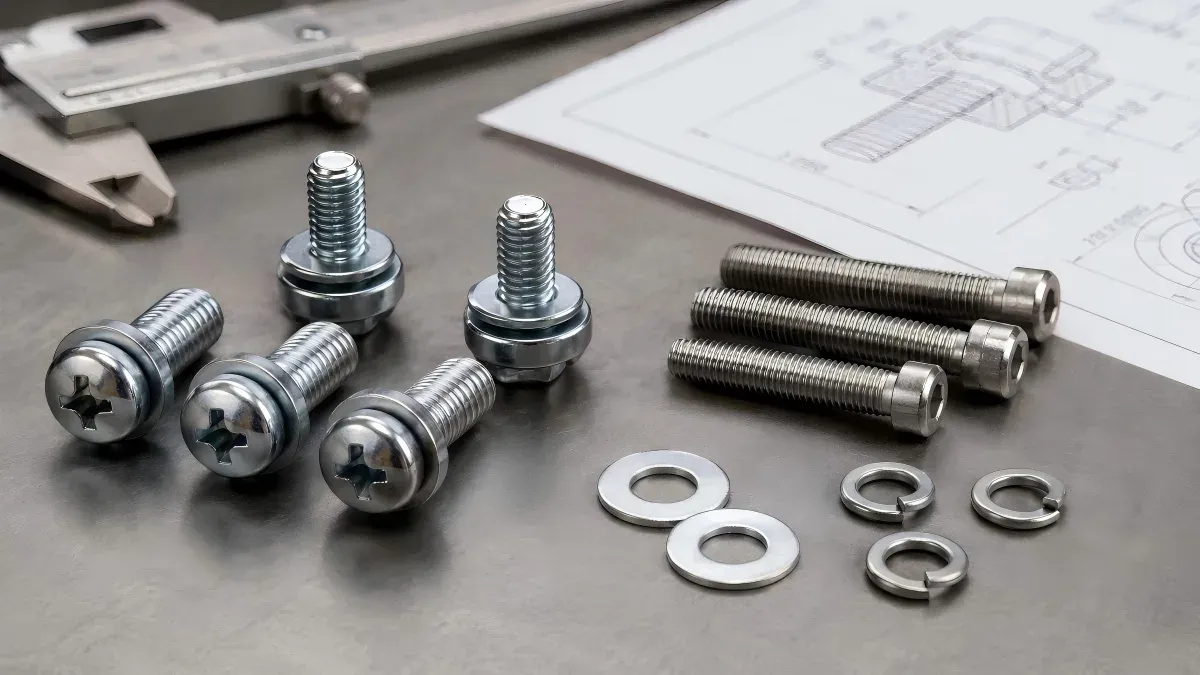
SEMS screws are screws with pre-assembled washers. The washer is already placed on the screw before delivery, and it is normally retained by the thread so it does not fall off easily.
For many OEM assemblies, buyers need to decide whether to use normal screws with separate washers, or SEMS screws with washers already assembled. Both options can work, but they are not the same in production.
The right choice depends on assembly speed, washer type, quantity, cost and quality control.
What Is a SEMS Screw?
A SEMS screw is not just a screw and washer packed together in one bag. The washer is assembled on the screw before the thread is fully formed, so it stays on the screw during handling and installation.
Common combinations include screws with flat washers, spring washers, tooth washers, or flat washer plus spring washer sets.
SEMS screws are often used in electrical products, machinery, appliances, automotive parts, brackets, covers and other repeated assembly work.
When SEMS Screws Are a Better Choice
SEMS screws are useful when every screw position needs a washer.
If workers need to pick up one screw and one washer separately, the process takes more time. There is also a risk that the washer may be missed, dropped, mixed with another size or installed in the wrong order.
With SEMS screws, the washer is already in place. This helps reduce assembly steps and makes production more stable.
For mass production, this can be more important than the small difference in unit price.
When Separate Washers Are Still Better
Separate screws and washers are still practical in many cases.
If the order quantity is small, or the design is still changing, separate washers give more flexibility. During testing, buyers may want to try different washer sizes, thicknesses or materials before confirming the final design.
Separate washers may also be better when the washer is large, special, very thick, or not suitable for stable pre-assembly.
So SEMS screws are not always necessary. They are most useful when the design is already stable and the same combination will be used repeatedly.
What Buyers Should Confirm
Before requesting a quote for SEMS screws, buyers should confirm the screw size, thread type, length, head style, drive type, material and surface finish.
The washer details are also important, including washer type, outside diameter, thickness, material and finish. Buyers should also confirm whether one washer or two washers are needed.
If the screw is used for grounding, locking, sealing or visible assembly, the washer type and finish should be checked carefully.
For custom SEMS screws, a drawing or sample is the best reference.
Packaging and Quality Control
SEMS screws need proper packaging because the washer is already assembled on the screw. If the finish is black, decorative or easy to scratch, packaging should be confirmed before mass production.
For export orders, clear labels by size, material, finish and quantity can help reduce warehouse mistakes and mixed parts.
Related Products
SEMS Screws Machine Screws Self-Tapping Screws Flat Washers Split Lock Washers Star Washers Custom Screws
Final Note
SEMS screws are a good option when assembly speed, consistency and missing-part control are important.
For small orders or changing designs, separate screws and washers may still be better. But for repeated OEM assembly, SEMS screws can help reduce handling, improve production stability and avoid washer-related mistakes.
Hextro supports SEMS screws, machine screws, self-tapping screws, washers and custom fastener combinations according to drawings, samples and application requirements.