Guides
How to Choose Blind Rivets: A Practical Guide to Size, Grip Range and Materials
Learn how to choose blind rivets (pop rivets) by diameter, grip range, head style, material and tool compatibility. Practical tips for reliable fastening.
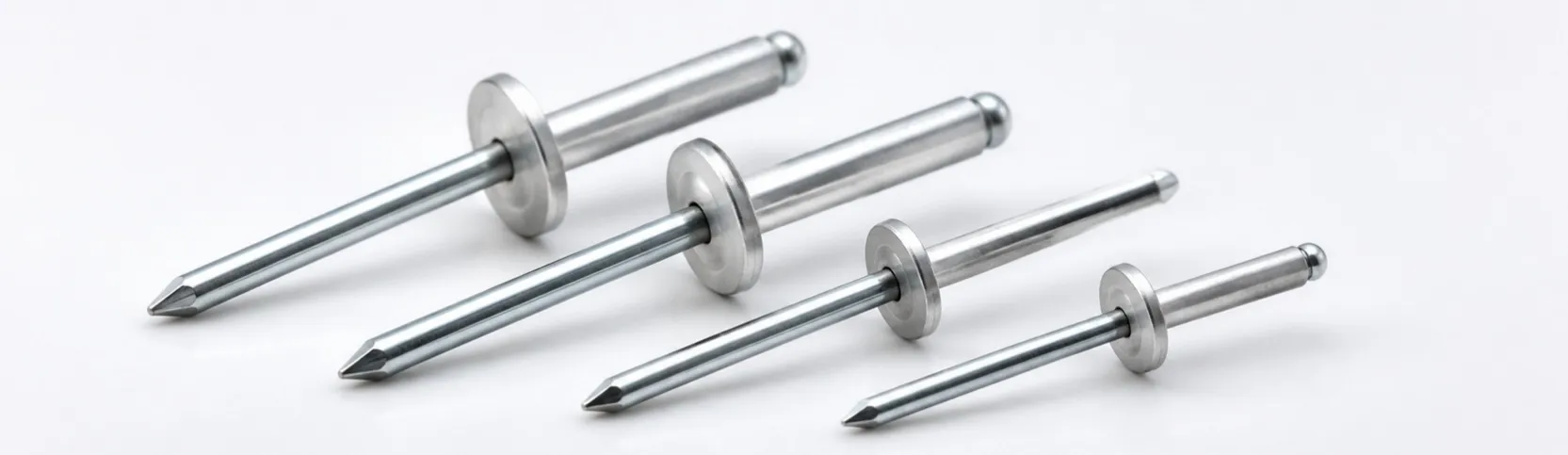
Blind rivets, also called pop rivets, join materials when access is available from only one side. They are widely used in sheet-metal assemblies, electrical enclosures, HVAC equipment and other industrial products.
Choosing the right rivet involves more than matching diameter and length. Grip range, head style, material, hole size and tool compatibility all affect the finished joint.
1. How Do Blind Rivets Work?
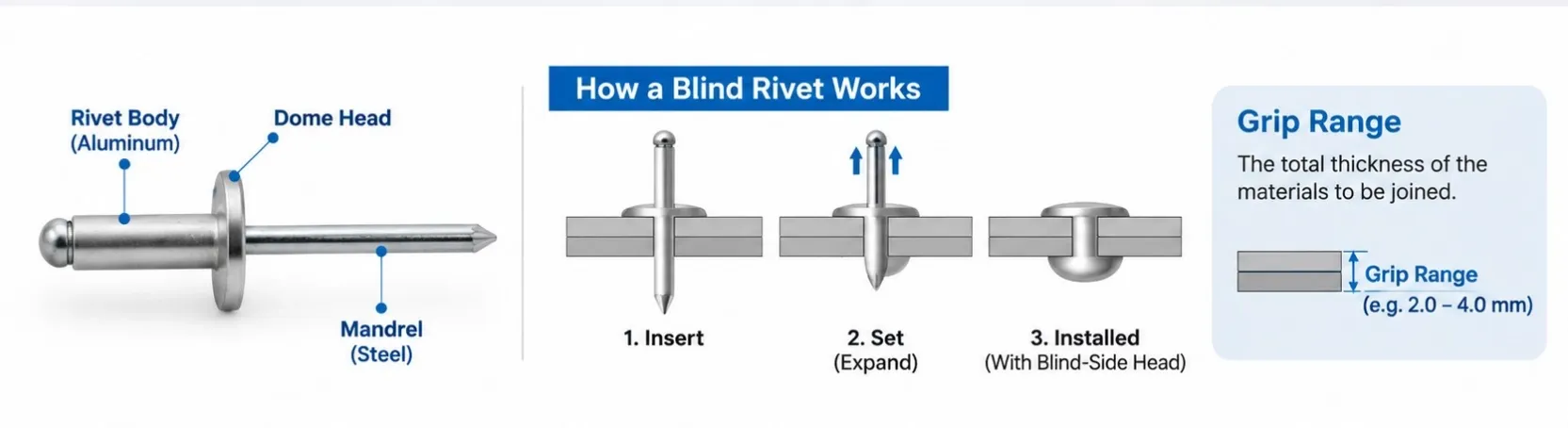
A standard blind rivet consists of a rivet body and a mandrel, also called a stem. The rivet is inserted through aligned holes in the materials. A compatible tool pulls the mandrel, causing the rear of the rivet body to expand and form a closing head on the blind side.
When the mandrel reaches its designed break point, it separates. The remaining rivet body holds the materials together. Because installation is performed from one side, blind rivets are useful where the back of an assembly is difficult to reach.
“Pop rivet” is a widely used name for this type of fastener. When ordering, specify the dimensions, material and rivet type rather than relying on the name alone.
2. Select the Correct Grip Range
Grip range is the total thickness of the materials that a particular rivet is designed to join.
For example, if two sheets are 1.0 mm and 1.5 mm thick, their combined grip thickness is 2.5 mm. The selected rivet’s published grip range must include that measurement.
A rivet used outside its specified grip range may not form the closing head or clamp the materials correctly. This can result in a loose joint, poor setting or damage to the workpiece.
Measure every layer in the joint, including coatings or additional components where relevant. If thickness varies between assemblies, check both the minimum and maximum conditions against the rivet’s grip range.
Do not choose a rivet by body length alone. Confirm the grip-range specification for the exact rivet series.
3. Match Rivet Diameter and Hole Size
Common blind rivet diameters include 2.4 mm, 3.2 mm, 4.0 mm and 4.8 mm, although availability varies by product series.
The appropriate diameter depends on the materials being joined, required joint performance, available space and the rivet manufacturer’s specifications. Hole size is equally important.
The recommended hole diameter is not necessarily identical to the rivet’s nominal body diameter. A hole that is too small can make insertion difficult; an oversized hole may affect setting quality and joint performance.
Check the specified hole diameter, alignment, edge distance and spacing. Remove excessive burrs and follow the selected rivet’s technical data; there is no universal hole-size rule.
4. Choose the Head Style and Material Combination
Head style affects the bearing surface, appearance and suitability of a rivet for a particular assembly.
- Dome head: A common general-purpose style with a rounded, protruding head, suitable for many applications where a raised head is acceptable.
- Large flange head: Provides a wider bearing surface and may be useful for thin sheet or softer materials, subject to the application and product specifications.
- Countersunk head: Used when a flush or low-profile surface is required. The workpiece needs a countersunk hole that matches the rivet head geometry.
Blind rivets are available in different body and mandrel combinations, including aluminum/aluminum, aluminum/steel, steel/steel and stainless steel/stainless steel.
An aluminum body with a steel mandrel is a common option for general-purpose fastening where low weight and practical installation are important. The right combination, however, depends on the service environment and required joint performance.
Consider corrosion resistance, contact between dissimilar metals, operating temperature and mechanical requirements. In damp or corrosive environments, galvanic corrosion may be a concern when dissimilar metals are in contact.
If a drawing specifies an industry standard, confirm that the exact rivet offered complies with it. Similar appearance alone does not establish compliance.
5. Check the Installation Tool and Validate the Joint
The riveting tool must suit the selected rivet. Check that it supports the rivet diameter, has sufficient pulling capacity and stroke, and uses a compatible nosepiece.
Manual tools may suit low-volume work, while pneumatic and battery-powered tools are common in repetitive production. Follow the tool manufacturer’s compatibility recommendations.
Before production, carry out a trial installation using the actual materials and hole dimensions. Check that the rivet inserts correctly, the head seats against the workpiece, the blind-side head forms properly and the mandrel breaks as intended. Look for distortion or damage around the hole.
For joints subject to significant loads, vibration or safety requirements, visual inspection alone is not enough. Review the relevant tensile and shear data and carry out application-specific testing where necessary.
6. What Should Buyers Include in an RFQ?
Complete information helps a supplier identify a suitable rivet and prepare an accurate quotation. Where possible, include:
- Diameter and length: Required dimensions or the existing part number.
- Grip range: Combined thickness of all materials being joined.
- Head style: Dome head, large flange or countersunk.
- Materials: Rivet body and mandrel, plus any coating or finish requirement.
- Hole size: Existing or specified hole diameter.
- Application: Materials being joined and operating environment.
- Performance or standards: Required tensile or shear performance, specification or standard.
- Quantity: Order quantity and estimated annual usage, if available.
A drawing, sample or clear photograph can help clarify the requirements. If details are missing, describe the application so they can be confirmed before ordering.
Need Blind Rivets for Your Project?
Selecting a blind rivet means matching the fastener to the complete joint—not simply choosing the lowest price or a similar-looking part. Correct grip range, hole dimensions, material combination and tool compatibility help reduce setting problems and improve assembly consistency.
Hextro supplies fastening components for industrial applications, including aluminum dome head blind rivets and other standard and custom fasteners. Send us your drawing, sample or application details and estimated quantity. We can review the requirements and discuss a suitable option for your project.