Oct 20, 2026Quality Control
Nylon Insert Lock Nuts vs All-Metal Lock Nuts: Which One Should You Use?
Compare nylon insert lock nuts and all-metal lock nuts, and learn which locking nut is better for vibration, temperature, reuse and industrial assembly.
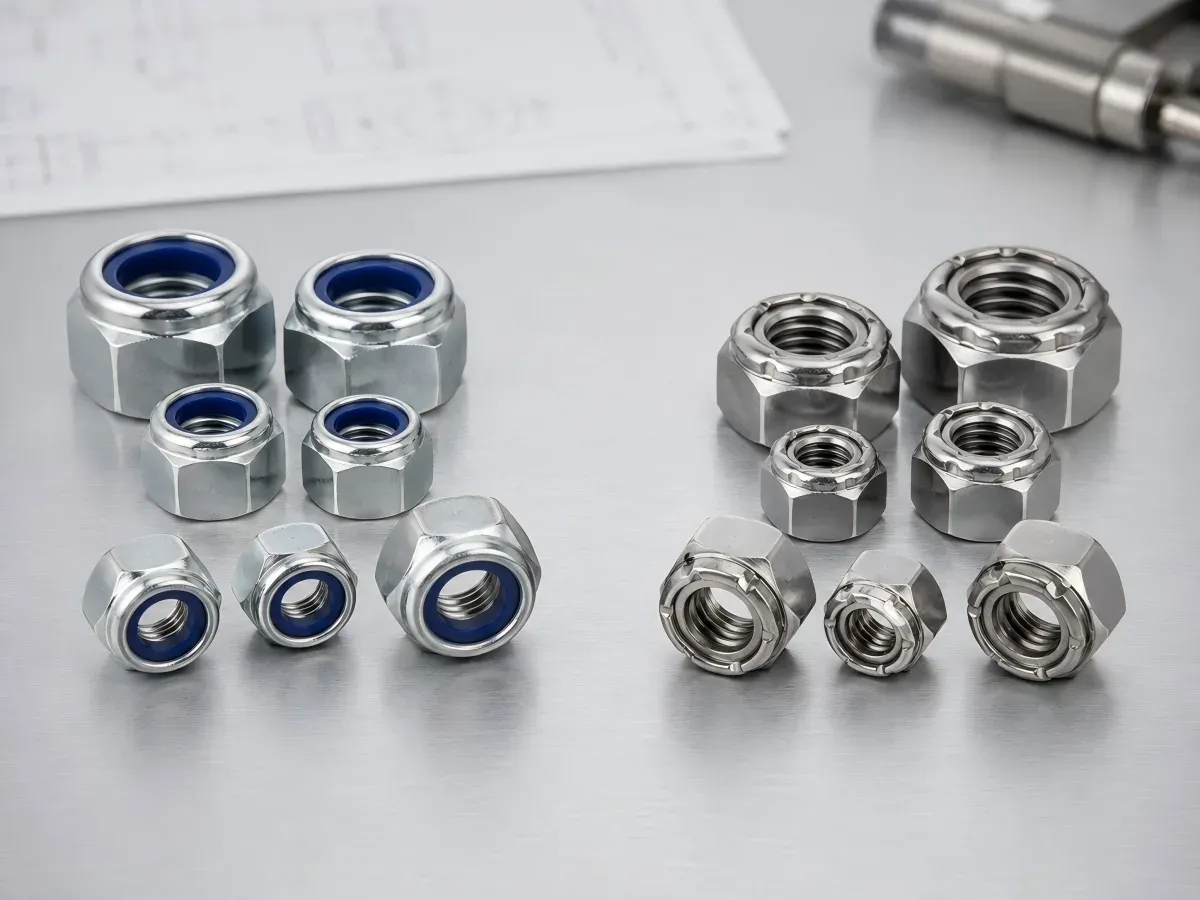
Lock nuts are used when a normal nut may loosen under vibration, movement or repeated loading. Two common options are nylon insert lock nuts and all-metal lock nuts.
Both can help resist loosening, but they are designed for different working conditions. The right choice depends mainly on temperature, vibration level, installation torque, reuse requirement and cost.
Nylon Insert Lock Nuts
Nylon insert lock nuts, also called nyloc nuts, have a nylon ring at one end of the nut. When the bolt thread passes through the nylon insert, the nylon creates extra friction against the thread.
This friction helps reduce loosening during vibration and normal movement.
Nylon insert lock nuts are widely used in machinery, equipment, furniture, electrical products, light vehicles and general industrial assemblies. They are easy to use, commonly available and cost-effective for many normal applications.
The main limitation is temperature. If the working temperature is too high, the nylon insert may lose locking performance. Chemical exposure, aging and repeated reuse can also reduce the locking force over time.
Use nylon insert lock nuts when the application needs reliable locking under normal temperature conditions and does not require high heat resistance.
All-Metal Lock Nuts
All-metal lock nuts do not use nylon or other non-metallic inserts. Their locking function comes from metal-to-metal prevailing torque, usually created by a deformed thread, distorted top or special nut shape.
Because there is no nylon part, all-metal lock nuts are more suitable for higher temperature environments. They can also be used where nylon is not acceptable because of heat, chemicals or application requirements.
All-metal lock nuts are often used in machinery, automotive parts, heavy equipment, metal structures and tougher industrial assemblies.
The main point to consider is installation torque. All-metal lock nuts may require higher torque during assembly. They can also cause more thread wear if reused many times or matched with unsuitable bolts.
Use all-metal lock nuts when the application involves higher temperature, stronger vibration or tougher working conditions.
Simple Selection Logic
If the assembly works at normal temperature and the main purpose is general vibration resistance, nylon insert lock nuts are often practical and economical.
If the assembly faces higher temperature, more demanding working conditions or restrictions on non-metallic locking materials, all-metal lock nuts may be the better choice.
Reuse should also be reviewed. Both types can lose locking performance after repeated assembly. For important applications, locking torque should be checked instead of assuming unlimited reuse.
What Buyers Should Confirm
Before requesting a quote, buyers should confirm the nut size, thread standard, material, grade, surface finish and quantity.
It is also useful to provide the working temperature, vibration level, bolt material, application, assembly method and whether the nut will be reused.
If there is a torque requirement, drawing, standard or approved sample, it should be provided before quotation.
Related Products
Hex Nuts
Flange Nuts
Bolts
Custom Fasteners
Final Note
Nylon insert lock nuts and all-metal lock nuts are both useful, but they should not be selected only by habit.
For normal temperature and general vibration resistance, nylon insert lock nuts are usually a good starting point. For higher temperature or tougher industrial environments, all-metal lock nuts should be reviewed.
Hextro supports nylon insert lock nuts, all-metal lock nuts, hex nuts, flange nuts, bolts, washers and other custom fasteners according to drawings, samples and application requirements.